
Leavenworth County Probate Records Overview
Probate in Leavenworth County is not handled by a standalone county probate court. Kansas places probate in District Court, and the research identifies the local probate route as Leavenworth District Court at 601 S. 3rd Street, Suite 3051, Leavenworth, Kansas 66048. That same court handles estates, wills, trusts, refusal to grant letters, guardianships, conservatorships, termination of joint tenancy, termination of life estate, and probate transcripts from other counties or states.
The District Court fee schedule is the local source for probate filing fees. Source: Leavenworth District Court docket fees.
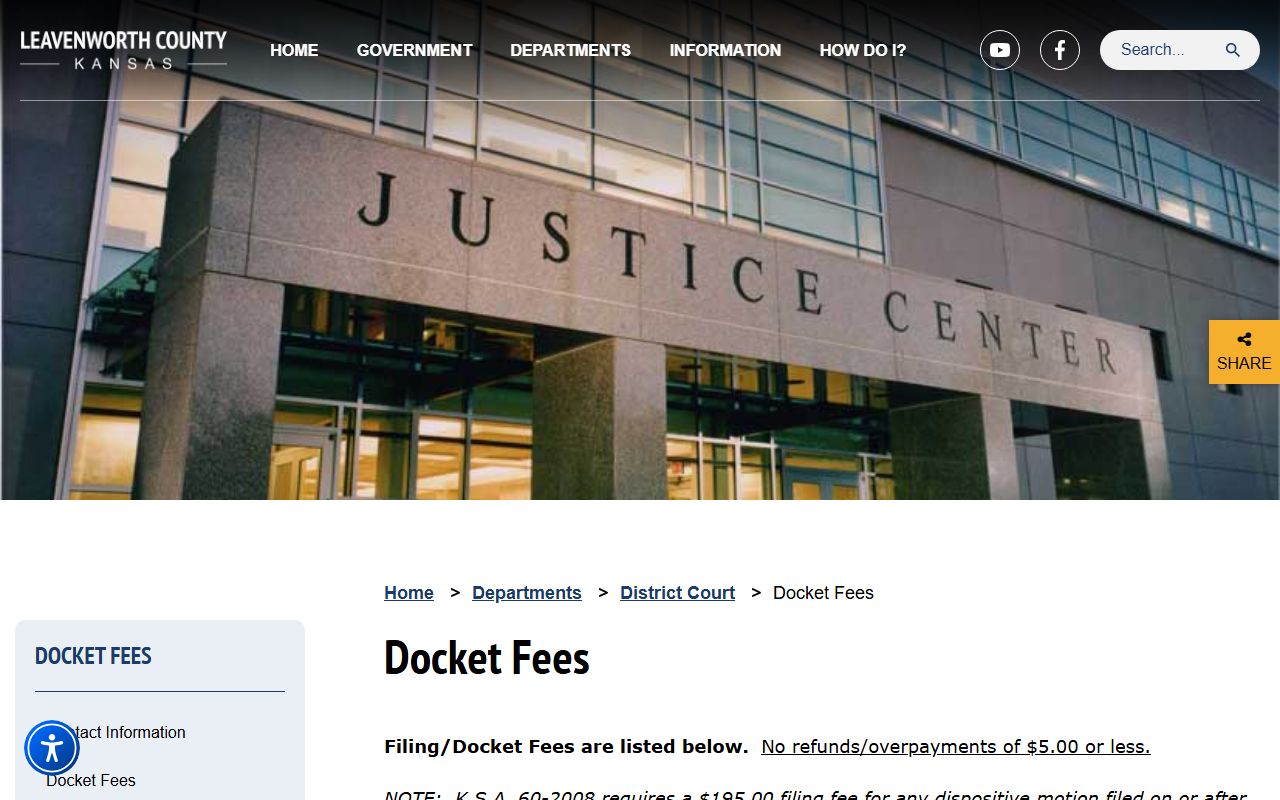
The fee page confirms that probate filings are part of the District Court docket system in Leavenworth County.
Probate records are often useful for heirs, creditors, buyers researching title issues, people checking whether a will was filed, and family members trying to locate estate administration papers. A public file may show the estate name, case number, petitions, notices, inventories, accountings, letters, orders, claims, and closing documents. Guardianship and conservatorship files can contain sensitive details and should be treated as court-supervised protective matters, not as ordinary estate files.
Leavenworth County Probate Terms
Probate language can be terse in Kansas court records. These terms help decode a Leavenworth County probate docket or file request before contacting the clerk.
- Testator
- A person who made a will.
- Executor
- A person named to carry out the will and administer the estate after appointment.
- Intestate
- Dying without a valid will, which shifts estate administration to Kansas intestacy rules.
- Guardianship
- Court-supervised responsibility for the care of a person who needs protection.
- Conservatorship
- Court-supervised management of a person's money, property, or financial affairs.
- Letters
- Court-issued authority, such as letters testamentary or letters of administration, proving who may act for an estate.
Search Leavenworth County Probate Records
Start with Kansas Judicial Branch CaseSearch for public District Court probate cases. If the record is older, not online, or available only as a courthouse record, use the public terminal at the courthouse or ask the Clerk of the District Court for a copy. The clerk's records process asks requesters to include the case number or book and page when known, and the clerk estimates cost before copies are mailed.
- Search Kansas CaseSearch by available name, estate name, case number, or county when the portal allows it.
- If the record is not online, use the courthouse terminal for public District Court records that do not appear in the portal.
- For copies, contact the Clerk of the District Court and identify the probate case or book and page as precisely as possible.
- Wait for the clerk's cost estimate, then send payment and a self-addressed stamped envelope if the copies will be returned by mail.
- Ask for certification when the probate document must be filed with another agency, title company, court, or financial institution.
Note: Sealed records and sealed documents will not become public through CaseSearch or a courthouse terminal.
Leavenworth County Probate Court Contact
The probate court for Leavenworth County is the Probate Division of District Court. The same local District Court contact information applies for probate copy requests, filings, and certified court-file documents. County administrative KORA custodians at 300 Walnut do not replace the court clerk for probate case files.
Probate Division of District Court
Leavenworth District Court
601 S. 3rd Street, Suite 3051
Leavenworth, KS 66048
913-684-0700
Fax: 913-684-0492
Clerk of the District Court
Records clerk route for copies and certification
601 S. 3rd Street, Suite 3051
Leavenworth, KS 66048
913-684-0716
Leavenworth County Probate Fees
The District Court docket fee schedule lists probate charges by filing type. These amounts are filing fees, not attorney fees, publication costs, title costs, or copy costs. Copy and certification charges are separate when someone requests a paper or certified copy from the court file.
| Probate filing | Fee |
|---|---|
| Adoption | $70.50 |
| Foreign adoption | $36.00 |
| Conservatorship and/or guardian | $91.50 |
| Probate trust | $91.50 |
| Filing will and affidavit | $70.50 |
| Probate descent | $71.50 |
| Probate estates | $131.50 |
| Probate transcript from another county | $45.50 |
| Probate transcript from another state | $195.00 |
| Refusal to grant letters | $70.50 |
| Termination of joint tenancy | $70.50 |
| Termination of life estate | $70.50 |
Small Estate Probate Records
Kansas provides a small estate affidavit process under K.S.A. 59-1507b. The Kansas Judicial Council also provides an official small estates affidavit form. The research notes that this affidavit is not the same as a full probate estate filing. It can be useful for qualifying personal property estates, but the current form and statute should be checked before relying on a fixed threshold or using the affidavit for a specific asset.
The Kansas statute page gives the legal source for small estate affidavits used with Leavenworth County probate records. Source: K.S.A. 59-1507b.
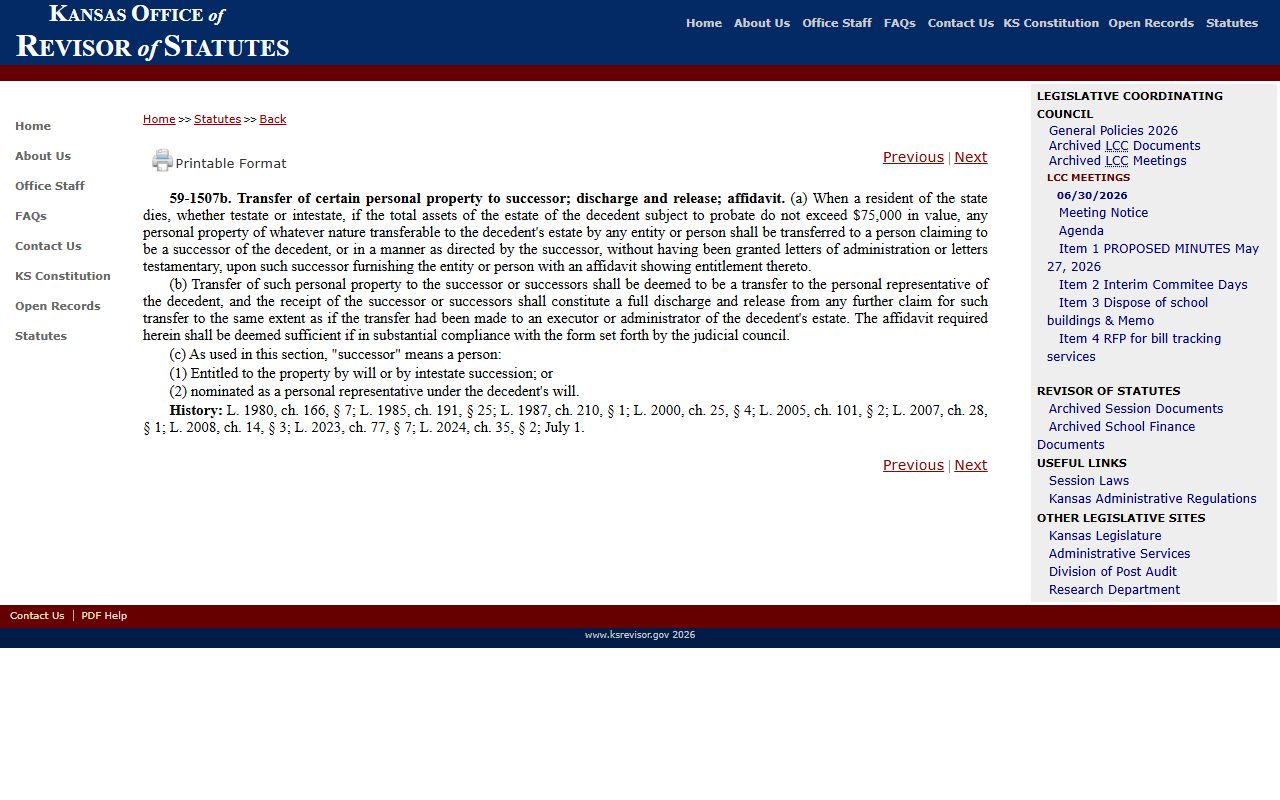
The small estate statute is a shortcut for some property transfers, but it does not make every estate exempt from court review.
What Leavenworth County Probate Records Show
A probate case file may contain the petition or application, the will and affidavit if filed, letters testamentary or letters of administration, heirship or descent materials, notices to creditors, proof of publication, inventory and valuation, claims, objections, accountings, distribution orders, guardian or conservator reports, and final settlement papers. Not every file has every item. A simple will filing can look very different from a contested estate or an ongoing conservatorship.
| Field or document | What it can show |
|---|---|
| Case number | The District Court identifier needed for copy requests. |
| Estate name | The decedent, protected person, or trust involved. |
| Petition | The relief requested, such as administration, descent, or guardianship. |
| Letters | The person authorized to act for an estate or protected person. |
| Inventory | Property and value information, subject to redaction or limits. |
| Order | The judge's ruling, authority granted, or case closing action. |
Restricted Leavenworth County Probate Records
Probate is generally a District Court record category, but that does not make each document open. Adoption records are generally confidential. Guardianship and conservatorship matters may contain medical, financial, minor, or protected-person information. Personal identifiers, account numbers, medical facts, and minor details may be redacted even when other parts of the case are public.
When a probate file is missing from CaseSearch, the reason may be technical, historical, or legal. Older records may not be online. Some public records may require courthouse-terminal access or a clerk request. Closed or sealed documents remain restricted. For a certified copy, the clerk can explain whether a public document exists and what copy fees apply, but the clerk cannot give legal advice about estate rights.
Leavenworth County probate records can also overlap with land, tax, and administrative records. A termination of joint tenancy or life estate may affect title research, but the court order is still a District Court record and the deed record is handled through land-record channels. A guardianship file may show that the court appointed someone to act, while later financial records may be limited. When a user needs proof of authority, the exact document matters: letters, an order appointing a guardian, an estate-closing order, or a certified copy of a will filing can serve different purposes.
Copy requests should be narrow. The clerk can search more efficiently when the request includes the estate name, protected person's name, case number, approximate filing year, and the specific document needed. Broad requests for an entire probate file can trigger more pages, more staff time, and more review for restricted material. If the record is being used for a bank, title company, court, or agency, ask that institution whether it needs a certified copy before ordering.